From Guesswork to Gold Standard: How I Built a Company-Wide QA Framework from the Ground Up
When I joined StudySmarter as a content writer, I knew nothing about quality auditing because it wasn’t part of my role.
A few months later, I became a Quality Auditor. That’s when I realised: there wasn’t a real auditing process in place.
No documentation. No guidelines. No shared standards.
Every QA was reviewing peer-written study articles based on their own habits or assumptions. And with hundreds of pieces of content being written across every A-Level and GCSE subject, that inconsistency wasn’t just frustrating, it was unsustainable.
The problem wasn’t the people, it was the system (or lack of one)
Each auditor was reviewing peer-written content based on their own memory, habits, or judgment. That meant:
No one was doing anything wrong, there just wasn’t anything official to do it right.
So I built the system I needed…and then it scaled
At first, I created a checklist just for myself.
I needed structure. I needed to know I wasn’t missing steps.
And if I was going to do this job well, I wanted to do it consistently.
So I started documenting everything: What to check. How to check it. Why it mattered.
I collaborated with a colleague already in the QA role — we refined it together. Then, when two new QAs joined our team, our subject manager asked if I’d be open to sharing my process.
They used it. Gave feedback. We improved it again.
Then our manager shared it with her boss…and just like that, it became the new QA standard.
What went into the framework?
Everything an auditor needed to deliver high-quality, consistent reviews — across subjects and writers.
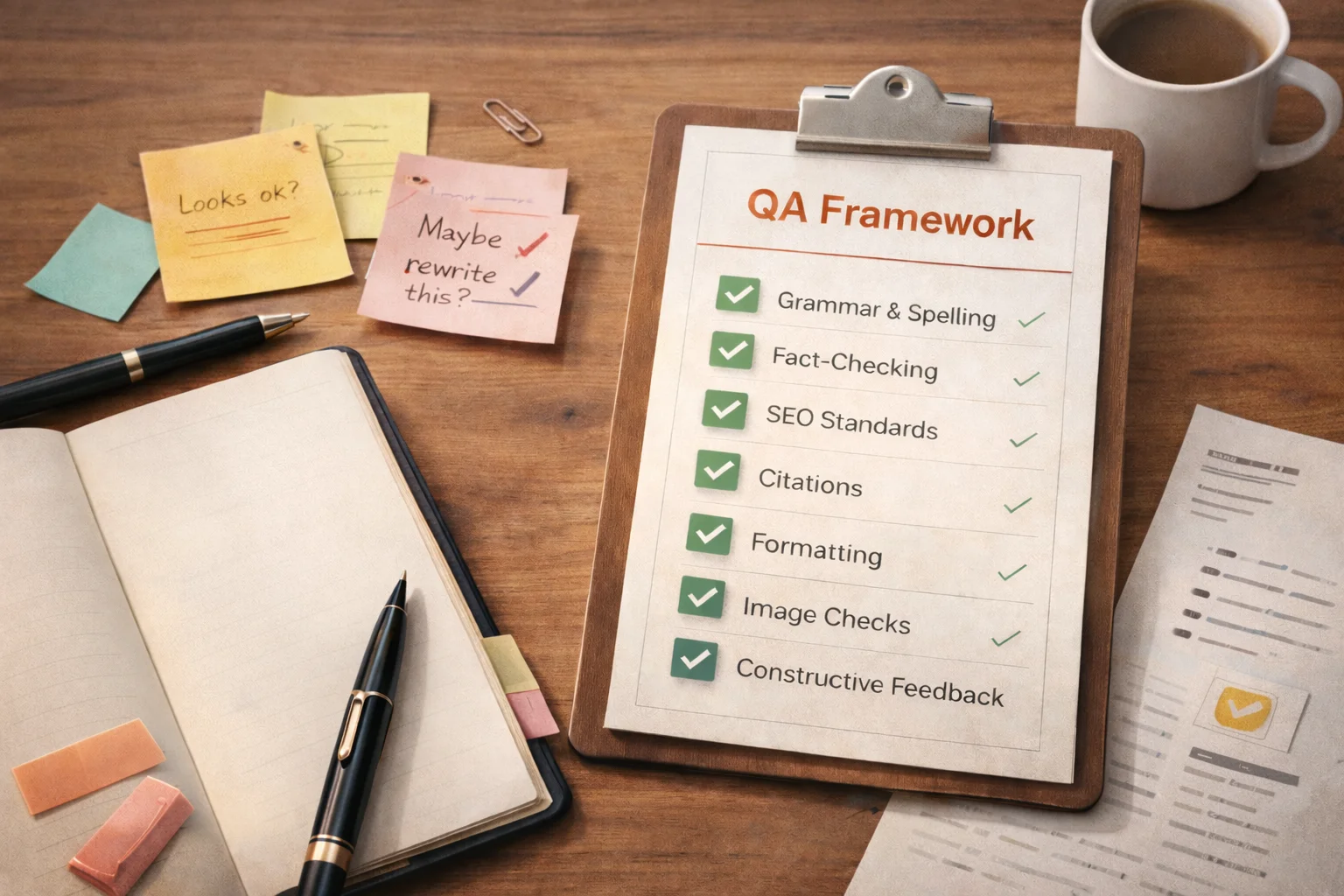
The checklist included:
What started as a personal Google Doc eventually became a Confluence-based knowledge hub used across all teams.
The result? Quality that scaled — and stuck
It didn’t just improve article quality. It made quality possible at scale.
The real win?
I didn’t build this because someone asked me to.
I built it because I needed it…and it turned out, everyone else did too.